

The Rise of HBCU dance
Discover the legacy, power, and rhythm behind historically Black college and university dance lines. From pioneering halftime shows to global viral phenomena, explore how these teams shaped a cultural movement that continues to inspire audiences worldwide.
Groundbreaking origins on the field
The World Renowned Golden Girls are often referred to as “Muva” (mother), as they. are the foundation of this new dance tradition. Their influence didn’t just stop with their own team. Other HBCUs began developing expanding their own dance lines. This new style of dance only continued to grow and take on new forms.
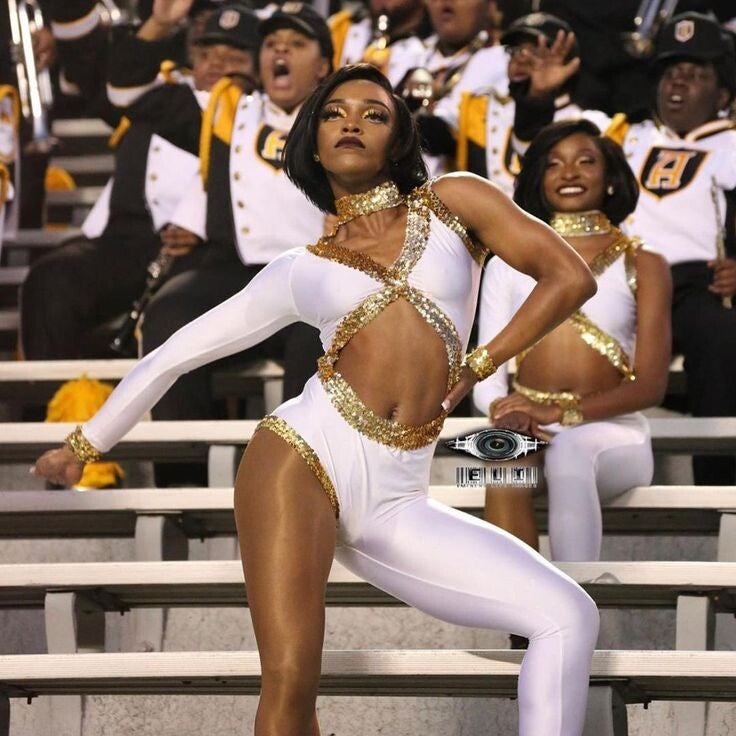
As different teams established their own identities, majorette also developed a language of movement that dancers and viewers soon began to recognize. Counts, also known as as catch-ons or stands, are on a count of 8 or 16 and allow a captain or lead dancer to begin a sequence of movements that the rest of the team will follow. These arrangements can be performed in the stands or incorporated into larger choreographed routines. Dance Magazine describes stand routines as “a form of call-and-response danced in the bleachers just feet away from spectators” (Ford 43). However, knowing counts goes far beyond memorizing just one or a couple routines. Majorette dancers build a large vocabulary of counts that they learn, practice, and continue to carry from each season. Some counts may be new while others can be passed down from decades. These counts are taught and practiced, but dancers don’t necessarily know which one will be used or the order they are performed. This requires dancers to have a strong memory and be ready to follow what is given to them. At the same time, the captain has to make creative decisions in the moment, choosing movements and formations that fit the music, the space, and situation.
The Sensational Stingettes | MCC 2019 Performance
The Sensational Stingettes (2019) of Alabama State University demonstrate the importance of formation calls and awareness. Even after falling in the front row, one dancer quickly got back up and rejoins the routine. Janae Harrison, the captain and lead dancer, shows how quickly captains must think when choosing counts and calling formation changes.
Southern Fabulous Dancing Dolls Field Show Routine
The Southern Fabulous Dancing Dolls showcase their agility and technique through a field show routine including turns, leaps, and other controlled movements.
This is where memory, technique, and awareness all begin to work together. Modern majorette also requires technical training. Dance magazine describes today’s choreography as an “amalgam of jazz, hiphop, and ballet” (Ford 43). These different styles contribute to the versatility needed for the majorette style of dance. Field-show routines allow dancers to showcase skills that can’t always be shown in the limited space of bleachers. Skills like jumps, leaps, turns, kicks, and other stunts are performed along with other dance movements all while staying in sync with the music and rest of the team. Dance magazine describes field routines as including movements ranging from bucking to grand battlements, showing how different dance influences come together within the entirety of majorette.
Technical training also affects the way a dancer uses their body. A dancer must know when a movement needs to be sharp and controlled or when it needs to flow from one movement to another using their entire body. But the movement itself is not the only thing dancers have to pay attention to. They must listen to the music and marching band while watching their captain for cues. Captains use specific hand signals to communicate formations, day dancers must stay aware of their spacing, timing, and surroundings to adjust when needed. In majorette, a sharp movement can be called a stick, while the flowing through a movement is often called milking. Being able to execute both requires body awareness and control. This combination of technique and musicality is what makes this type of dance so unique.